New Patients
Existing Patients
New Patients
Existing Patients
New Patients
Existing Patients
New Patients
Existing Patients

Advances in dental materials and restorative techniques have made replacing missing teeth more natural-looking and functional than ever. While fixed options such as dental implants and bridgework are excellent solutions for many patients, removable dentures continue to be a reliable and adaptable way to restore oral function and facial support when one or more teeth are lost.
At the office of RGV Smiles by Dr. Rocky L. Salinas, DDS, PA, we use carefully selected materials and thoughtful design to create dentures that fit well, look natural, and support your comfort and confidence. Our approach balances form and function so dentures do more than fill a gap — they help restore clear speech, comfortable chewing, and a balanced facial appearance.
We take a personalized approach to denture care, tailoring treatments to the health of your oral tissues, your daily habits, and the lifestyle you want to maintain. Whether you need a partial to replace several teeth or a full set, our goal is to deliver a prosthesis that supports long-term oral health and makes daily life easier.
Losing teeth alters how your mouth works and how your face looks. Missing teeth reduce biting surfaces, change chewing patterns, and can lead to uneven wear or movement of remaining teeth. Over time, these changes can make eating uncomfortable and affect the types of foods you enjoy.
Beyond function, tooth loss affects facial support. Teeth and their roots provide important structure for the cheeks and lips; when multiple teeth are missing, the soft tissues can appear sunken and the lower face may seem shorter. Replacing teeth with dentures restores support and can improve facial balance in a subtle but meaningful way.
The psychological impact of missing teeth is often underestimated. People commonly report feeling self-conscious about gaps or changes in their smile, which can influence social interactions and overall well-being. Early evaluation and timely replacement help preserve function, maintain oral health, and support confidence in everyday life.
Removable dentures are prosthetic devices that rest on the gums and are designed to replace one or more missing teeth. They combine artificial teeth set into a supportive base that follows the contours of the mouth. Because they are removable, these appliances allow routine cleaning of both the denture and the underlying tissues.
Partial dentures are intended to replace several missing teeth and often attach to remaining natural teeth using clasps or precision attachments. Full (complete) dentures replace all teeth in an arch and rely on the shape of the mouth, suction, and, when appropriate, additional retention aids to stay in place. Each design prioritizes comfort, stability, and natural appearance.
Dentures are appropriate for a wide range of patients, including those who are restoring teeth after extractions, managing generalized tooth loss, or seeking a non-permanent alternative to fixed restorations. Our team evaluates oral health, jawbone condition, and the status of remaining teeth to recommend the most suitable denture type for each individual.

Selecting the ideal denture begins with a careful clinical assessment and a conversation about your priorities — comfort, appearance, and how you use your teeth daily. We consider the health of remaining teeth, the amount of available bone, and how the tissues respond to pressure when deciding between partial and full dentures or when recommending enhancements like attachments or implants.
Full dentures replace all teeth in an arch and come in several approaches based on timing and retention. A conventional full denture is fabricated after healing from extractions is complete. An immediate denture is placed at the time of extractions to avoid a period without teeth; it offers immediate aesthetics but may require follow-up adjustments as tissues heal.
Partial dentures are designed to integrate with your remaining dentition. They restore missing teeth while helping to stabilize adjacent teeth and maintain proper spacing. Modern partials can be constructed from metal frameworks, flexible resins, or hybrid materials, providing options for strength, comfort, and aesthetics.
Complete dentures can be tailored to meet different clinical situations. A conventional complete denture is made after mouth tissues have healed following extractions, which can provide a predictable fit. Immediate dentures are crafted in advance and placed right after teeth are removed to preserve appearance during healing.
Immediate denture
An immediate denture offers the advantage of never having to be without teeth after extractions. Because the mouth changes during healing, immediate dentures are commonly adjusted or relined later to maintain fit and comfort as tissues remodel.
Overdenture
An overdenture fits over remaining tooth roots or specially placed attachments, using those structures for added stability. This approach preserves bone and tissue relationships while providing enhanced retention compared with a standard complete denture.
Implant-supported dentures
When implants are an option, they can anchor a denture securely to the jaw. Implant-supported prostheses reduce slipping, improve chewing efficiency, and can make lower-arch dentures significantly more stable for everyday use.
Partial dentures are a conservative way to replace multiple missing teeth while preserving healthy structures. They prevent neighboring teeth from drifting into empty spaces, help maintain bite relationships, and restore a balanced chewing surface. The design always seeks to minimize pressure on natural teeth and to promote a comfortable fit.
Material choices affect how a partial feels and functions. Cast metal frameworks offer durability and precise fit, while flexible resin options prioritize comfort and esthetics. Our team will discuss the pros and cons of each material and select a design that aligns with your oral health and personal preferences.
Proper planning and laboratory collaboration are essential for a successful partial denture. Accurate impressions, shade selection, and trial fittings ensure that the final appliance integrates with your smile naturally and performs reliably in everyday use.
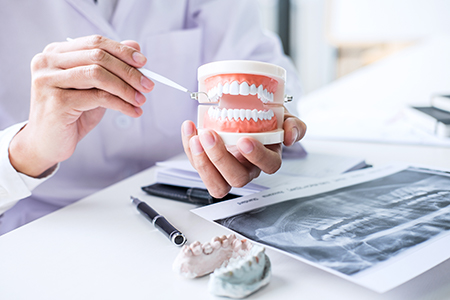
Creating a comfortable, well-fitting denture is a multi-step process that blends clinical judgment with technical skill. Precise impressions capture the shape of the mouth, framework try-ins confirm fit and support, and careful selection of tooth size and color ensures the prosthesis looks natural within the context of your face.
Occlusion — how your teeth come together — is a critical factor. An accurate bite relationship prevents uneven pressure and helps the denture function smoothly during chewing and speech. Adjustments during try-in visits are normal and help refine the prosthesis before final delivery.
Occasionally, pre-prosthetic treatments such as smoothing sharp bone ridges or removing non-restorable teeth are recommended to create a healthy foundation for a denture. These preparatory steps improve long-term comfort and reduce the need for extensive adjustments later.

Adjusting to a new denture takes time and patience. Early days often include increased saliva, minor speech changes, and localized pressure points that are addressed through professional adjustments. Regular communication with the dental team ensures sore spots are relieved and the fit is refined.
Eating with a denture improves gradually. Start with soft foods, cut items into small pieces, and chew on both sides of the mouth to distribute pressure evenly. With consistent practice, most patients regain confidence and expand their diet over several weeks.
Proper daily care preserves the appearance and longevity of a denture. Rinse and brush the appliance after meals, soak it overnight in water or a recommended cleaner, and maintain gentle oral hygiene for any remaining teeth and soft tissues. Removing dentures at night gives the gums a chance to rest and helps preserve tissue health.
Fit changes and maintenance
As the jawbone and gums remodel over time, relines or adjustments may be necessary to restore optimal fit. Periodic dental visits allow us to evaluate tissue health, examine any remaining teeth, and make refinements that prolong comfort and function.
Enhanced retention options
For patients who need additional security, adhesives, attachments, or implant support can be considered. These solutions reduce movement and can increase confidence during speech and eating.
Follow-up care
Ongoing checkups help catch early signs of wear, evaluate oral tissues, and ensure the denture continues to meet functional and esthetic expectations. Routine examinations are an important part of maintaining overall oral health.
Our team is committed to creating dentures that fit comfortably, perform well, and look natural. If you’re considering tooth replacement options or already have questions about your current prosthesis, our office offers experienced guidance and detailed planning to support your goals.
In summary, well-designed dentures restore function, protect oral health, and contribute to a balanced facial appearance. Contact us for more information about how dentures may fit into your treatment plan. We’re here to help you understand your options and move forward with confidence.


Dentures are removable prosthetic devices that replace missing teeth and the surrounding tissues to restore basic oral function. They consist of artificial teeth set into a supportive base shaped to follow the contours of the mouth, and they rely on careful design to distribute chewing forces and preserve comfort. A well-made denture helps restore clear speech, chewing ability, and facial support where natural teeth are absent.
Removable dentures are designed to be taken out for daily cleaning and overnight rest, which supports tissue health and hygiene. Retention is achieved through a combination of fit, suction, clasps on remaining teeth, or additional attachment systems when necessary. Regular dental follow-up ensures the appliance continues to function as intended as the mouth changes over time.
Dentures are appropriate for patients who have lost several teeth or an entire arch and who seek a non-fixed alternative to bridges or implants. Candidates are evaluated based on oral health, the condition of remaining teeth, jawbone status, and overall health so the team can recommend the most suitable prosthesis. People who prefer a removable option or who need a timely solution after extractions often find dentures to be a reliable choice.
A thorough clinical exam identifies any preparatory needs, such as smoothing sharp bone edges or removing non-restorable teeth, to create a comfortable foundation. Your dental team will review how dentures align with your lifestyle, diet, and daily habits to ensure the final design supports long-term oral health and usability. In many cases, dentures are part of a staged treatment plan that can be combined with other restorative approaches if desired later.
There are several denture options tailored to different clinical situations, including partial dentures, conventional full dentures, immediate dentures, overdentures, and implant-supported prostheses. Partial dentures replace one or more missing teeth while integrating with remaining natural teeth using clasps or precision attachments, and full dentures replace all teeth in a single arch. Each type is selected based on the number of missing teeth, the health of remaining structures, and patient priorities for comfort and appearance.
Complete dentures can be fabricated after healing or provided immediately following extractions to avoid a period without teeth, with subsequent adjustments as tissues remodel. Overdentures use remaining roots or attachments for added stability and can help preserve bone, while implant-supported dentures anchor to dental implants for enhanced retention and chewing efficiency. Material choices and design features also vary to balance strength, esthetics, and patient comfort.
Designing a successful denture is a multi-step process that combines precise clinical assessment with laboratory craftsmanship to achieve a comfortable fit and natural appearance. The workflow typically includes accurate impressions, bite registration to establish occlusion, try-in appointments to evaluate tooth size and shade, and final delivery when fit and function meet clinical expectations. Occlusion and bite relationships are carefully managed to prevent uneven pressure and promote efficient chewing and clear speech.
During the treatment process your dental team will perform trial fittings and make incremental adjustments to refine fit and comfort before the final prosthesis is finished. Pre-prosthetic treatments such as smoothing bone ridges or extracting non-salvageable teeth may be recommended to optimize the foundation. At RGV Smiles by Dr. Rocky L. Salinas, DDS, PA, we emphasize collaboration with dental laboratories to ensure each denture integrates well with the patient’s facial features and functional needs.
An immediate denture is prepared in advance and placed at the same appointment as tooth extractions so the patient is never without teeth during the healing period. This approach preserves immediate appearance and function, but because the mouth changes as swelling subsides and tissues heal, follow-up visits are commonly needed to reline or adjust the prosthesis for continued comfort. Patients should expect an initial adaptation period with temporary pressure points that are addressed through professional adjustments.
After receiving an immediate denture, it is important to attend scheduled checkups so the dentist can monitor healing and make timely refinements. Once healing is complete, a more stable conventional denture or a relined immediate denture may be fabricated to accommodate long-term tissue changes. Clear communication with the dental team helps manage expectations and ensures the best possible outcome.
Implant-supported dentures use dental implants anchored in the jaw to secure a prosthesis, providing superior retention and chewing efficiency compared with conventional removable dentures. Overdentures are a hybrid approach that fit over remaining tooth roots or attachments and can also be supported by a smaller number of implants to improve stability and preserve bone. Both options reduce movement during function and can significantly improve comfort and confidence for many patients.
Choosing between implant-supported options and conventional dentures depends on bone volume, medical history, and patient goals for function and maintenance. Implant procedures require surgical placement and a healing period before prosthetic connection, and they may be offered when the patient is a suitable candidate for implant therapy. The dental team will assess your oral and systemic health to recommend the most appropriate retention strategy for long-term success.
Daily denture care preserves the appliance’s appearance and reduces irritation to the soft tissues beneath it. Rinse and brush the denture after meals to remove food particles, use a soft brush and nonabrasive cleanser designed for dentures, and soak the appliance overnight in water or a recommended cleaning solution to maintain hygiene. Removing dentures at night gives gum tissue a chance to rest and supports tissue health.
In addition to cleaning the denture itself, maintain gentle oral hygiene for any remaining natural teeth and the soft tissues, including brushing the gums, tongue, and palate to reduce bacterial buildup. Handle dentures carefully to avoid dropping or damaging the base or artificial teeth, and bring the prosthesis to dental appointments so the team can evaluate fit and perform professional maintenance when needed. Proper daily routines extend the life and performance of the appliance.
It is common to experience temporary changes in speech and eating when you first receive a new denture as your tongue, lips, and facial muscles learn to accommodate the appliance. Early adaptations may include increased saliva production, minor lisps, or pressure points that typically resolve with practice and professional adjustments. Starting with soft foods, cutting items into smaller pieces, and chewing on both sides of the mouth help distribute forces evenly during the learning period.
Regular practice speaking aloud, reading passages, or repeating difficult words can accelerate speech adaptation and build confidence. If persistent issues arise, the dental team can make targeted adjustments to improve fit and phonetics, and consider alternative retention strategies if necessary. With time and proper care most patients regain comfortable function and clear speech.
Routine dental checkups are important to monitor the fit, function, and condition of dentures as the jawbone and soft tissues remodel over time. Periodic visits allow the dentist to identify wear, evaluate oral tissues, adjust occlusion, and perform relines or repairs when necessary to restore optimal fit and comfort. Regular exams also help detect oral health concerns early, including changes in the mouth that can affect denture performance.
When tissues change significantly, relining or remaking the denture may be recommended to maintain stability and prevent sore spots. Prostheses that show signs of wear, cracking, or loss of vertical dimension should be repaired or replaced to ensure reliable function. Following a scheduled maintenance plan supports long-term oral health and the continued usefulness of the denture.
If you experience persistent soreness, sharp pressure points, loose fit, or damage to your denture, contact your dental team for an evaluation so the appliance can be adjusted or repaired as needed. Many common problems are resolved with simple in-office adjustments, relines, or laboratory repairs that restore comfort and function without extensive procedures. Prompt attention prevents minor issues from becoming more serious and supports uninterrupted oral function.
At our McAllen and Pharr offices we prioritize follow-up care and will work with you to address concerns, schedule timely adjustments, and provide guidance for at-home management during the interim. Keeping the denture clean, avoiding self-adjustments, and bringing the prosthesis to appointments helps the clinician assess and correct problems efficiently. Early communication with your dental provider ensures the best possible outcome and continued comfort.
Ready to take the next step toward a healthier, brighter smile?
Contacting RGV Smiles by Dr. Rocky L. Salinas, DDS, PA is the first step! Our supportive team is available to assist with all your needs, from booking routine care to discussing advanced cosmetic services. Simply call or use our online form to connect with us today. We make it easy to prioritize your oral health!

Back to top
